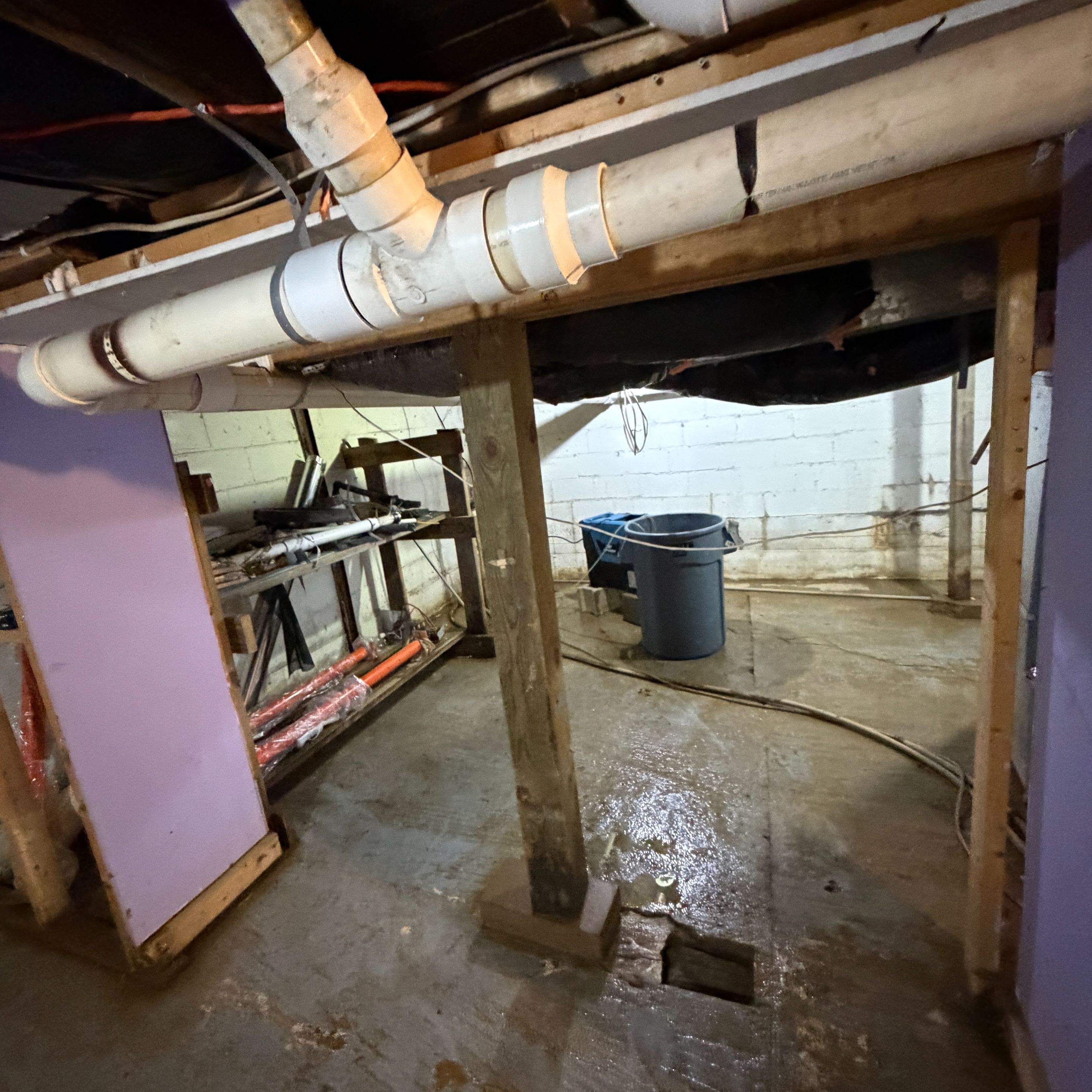
Why Crawl Spaces Behave Differently Than Basements
Before the comparison, you need to understand why crawl spaces resist drying. A basement has concrete walls, a poured slab, and usually some kind of mechanical ventilation pathway into the conditioned envelope of the home. A crawl space has dirt or a thin vapor barrier on the ground, limited airflow, low headroom, and joists and subfloor sitting just feet above standing water. Moisture has nowhere to go but up. That is why a crawl space at 70 percent relative humidity will rot your subfloor in a season while a basement at the same reading might just feel damp.
The IICRC S500 standard categorizes water by contamination level: Category 1 (clean supply line water), Category 2 (gray water with some contaminants), and Category 3 (black water from sewage or ground flooding). It also classifies drying difficulty by Class, with Class 4 covering low-evaporation materials like the wood framing, insulation, and earthen floors common in crawl spaces. Most Holliday Park crawl space jobs land in Class 3 or Class 4, which means longer drying times, more equipment, and stricter monitoring than a typical kitchen leak. If you want broader context on how categories drive cost, our complete water damage restoration cost breakdown walks through the math.
The other factor that makes crawl spaces uniquely difficult is access. Technicians work on their backs or bellies, often in 24 to 36 inches of clearance, dragging hoses and extension cords through tight openings. That changes how Holliday Park Water Restoration approaches equipment selection. We favor low-profile centrifugal air movers and ducted dehumidifier hoses over bulky stacked units, and we plan entry points before deploying anything heavy. A poorly staged crawl space job can take twice as long as the same volume of water in an open basement.
Comparing Four Common Crawl Space Scenarios
The table below covers the four scenarios we see most often in Holliday Park. Read it as a diagnostic tool. Match your symptoms to the closest row, then read the prose that follows to understand the implications.
| Scenario | Typical Cause | Water Category | Removal Method | Drying Time | Typical Cost Range | Insurance Outlook |
|---|---|---|---|---|---|---|
| Storm seepage | Heavy rain, poor grading, clogged gutters | Cat 1 to Cat 2 | Truck-mount extraction, sump pump | 3 to 5 days | $1,500 to $4,500 | Often denied as maintenance |
| Burst supply line | Frozen PEX or copper, failed fitting | Cat 1 | Extraction, dehumidifiers, air movers | 4 to 7 days | $2,500 to $7,000 | Usually covered (sudden and accidental) |
| Sewer backup | Main line failure, tree roots | Cat 3 | Full removal, antimicrobial, vapor barrier replacement | 7 to 14 days | $6,000 to $15,000+ | Covered only with sewer backup rider |
| Long-term seepage | Failed exterior waterproofing, plumbing drip | Cat 2 with mold | Extraction, demo of insulation, remediation | 10 to 21 days | $5,000 to $20,000 | Usually denied, mold sub-limits apply |
Reading the Table Honestly
Storm seepage is the most common call we get, and it is also the most contentious with insurance. Most Holliday Park homeowner policies treat groundwater intrusion as a maintenance issue tied to grading, gutters, and foundation drainage, not a covered peril. That does not mean you ignore it. A few inches of standing water in a crawl space will saturate fiberglass insulation, drop it onto the dirt, and turn your subfloor into a humidity sponge within 48 hours. We extract, pull wet insulation, set low-grain refrigerant dehumidifiers, and monitor moisture content in the joists daily until we hit drying goals.
Burst supply lines are the friendliest scenario from an insurance standpoint, even though the damage can be severe. Sudden and accidental discharge is the magic phrase your adjuster wants to hear. If a PEX line let go in February and ran for six hours before you shut the main, you are likely looking at a covered loss minus your deductible. Our frozen pipe burst repair guide covers the documentation steps that protect that claim.
Sewer backups are the scenarios that demand the most aggressive response. Category 3 water carries pathogens, and the porous materials it touches (insulation, exposed wood, vapor barriers) generally cannot be salvaged. We treat these jobs with full PPE, containment, and antimicrobial application, then replace the vapor barrier as part of restoration. If you suspect contamination, do not enter the crawl space yourself. Our sewage cleanup service page explains the protocol in detail.
Long-term seepage is the most expensive scenario by the time we find it, because mold has usually colonized the joist bays before anyone investigates. You will notice a musty smell on the first floor, allergy symptoms that worsen at home, or visible staining on baseboards. By then we are doing remediation, not just drying. Cost climbs because the scope expands into demolition, antimicrobial treatment, and rebuild. We have walked into Holliday Park crawl spaces where the original leak was a $40 supply valve, and the eventual remediation invoice cleared $18,000 because three winters of slow drip went unnoticed above an unconditioned space.
When to Call and What to Document
If you find standing water under your home, photograph everything before equipment arrives, then shut off the water source if it is plumbing related. Note the date, time, and weather conditions. Save any text messages or voicemails from neighbors or plumbers that establish when the loss began. Holliday Park Water Restoration responds to Holliday Park crawl space calls around the clock, and the sooner extraction starts, the better your odds of keeping the subfloor and joists intact rather than replacing them.
What Drying Actually Looks Like Under Your House
For every scenario above, the mechanical drying process follows the same physics. We extract free water first, remove unsalvageable porous materials, then set commercial dehumidifiers sized to the cubic footage and Class rating. Air movers create laminar flow across wet surfaces. We monitor with penetrating and non-penetrating moisture meters daily and adjust equipment placement until the framing reaches equilibrium with the surrounding dry standard. In a typical Holliday Park crawl space, that means 12 to 15 percent moisture content in the joists and subfloor, verified with documentation that supports your insurance claim.
Equipment sizing is where amateur jobs fall apart. A single rental dehumidifier from a hardware store moves roughly 50 pints per day under ideal conditions, while the LGR units Holliday Park Water Restoration deploys can pull 130 to 250 pints in the same window. In a 1,500 square foot crawl space saturated to Class 4 conditions, you may need three or four LGR units running in parallel with eight to twelve air movers. Undersizing equipment does not save money. It just stretches a five-day job into a three-week mold problem, and that is when restoration turns into remediation.