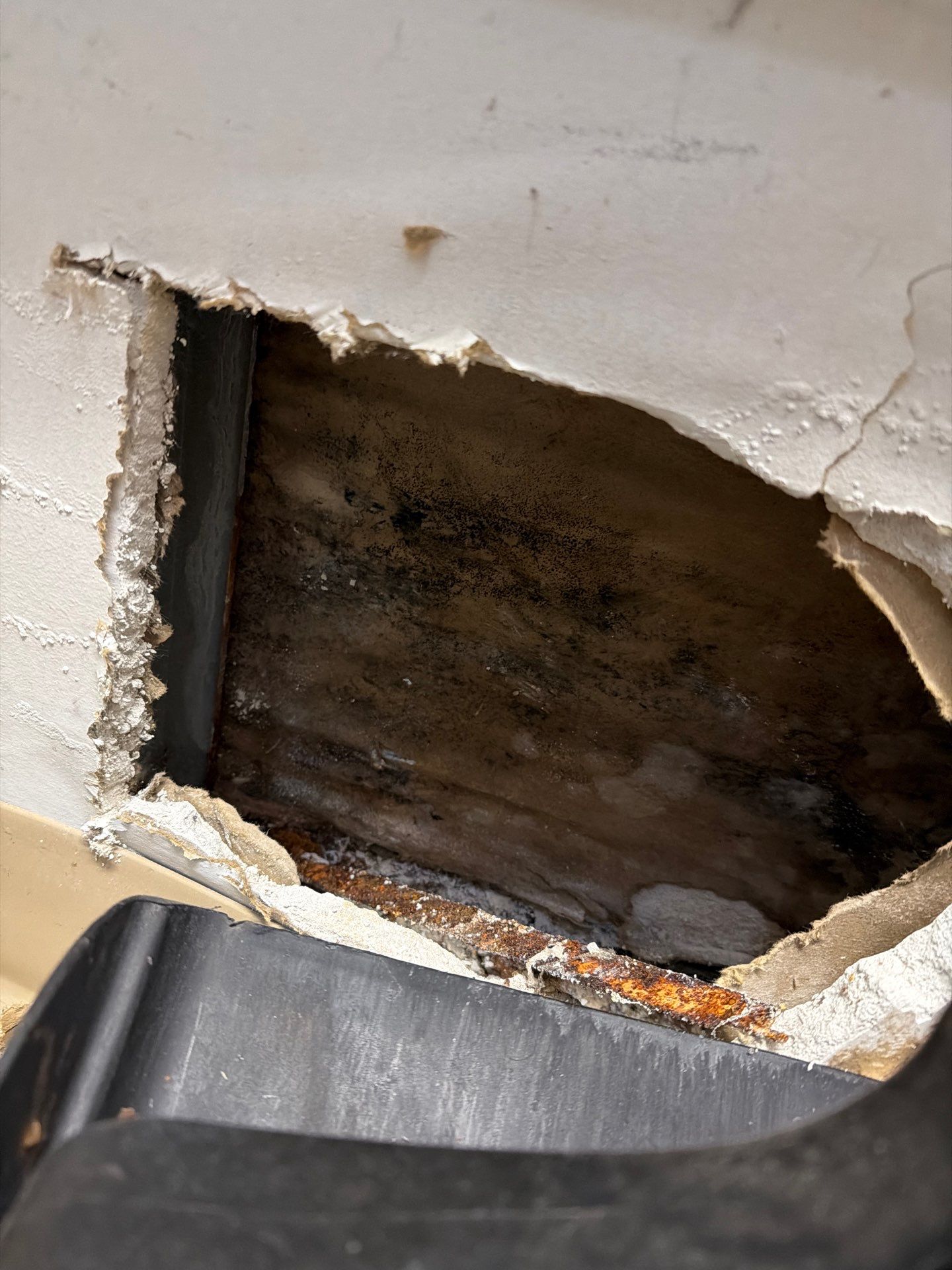
Quick Answer: How Hidden Leaks Are Found
Hidden water damage behind walls is detected through a combination of moisture meters, infrared thermal imaging, and targeted inspection openings. A trained technician can map a wet cavity in 20 to 45 minutes without tearing out drywall. DIY detection works for surface symptoms only. If you suspect a leak inside a wall in your Holliday Park home, document what you see, shut off the water supply to that zone, and schedule professional diagnostics within 24 to 48 hours.
Warning Signs of a Hidden Leak
Visual Cues
- Bubbling, peeling, or blistering paint on drywall or trim
- Brown or yellow staining shaped like rings or teardrops
- Warped baseboards, cupped hardwood, or lifting laminate seams
- Visible mold spotting near outlets, switches, or vents
- Nail pops or sagging sections of drywall ceiling
- Efflorescence (white crystalline deposits) on basement or foundation walls
- Rust streaks bleeding through paint near drywall screws
Sensory Cues
- Musty or earthy smell that intensifies near a specific wall
- Cold or damp spots when you place your hand on drywall
- Hissing or trickling sounds when fixtures are off
- Sudden spike in your water bill with no usage change
- Allergy or respiratory flare-ups isolated to one room
- Floors that feel spongy or shift slightly underfoot near a wall base
When Insurance Covers Hidden Leak Damage
- Sudden and accidental: usually covered (pipe burst, fitting failure)
- Long-term seepage over 14 days: typically excluded
- Resulting damage from a covered leak: often covered even if the pipe itself is not
- Mold: limited coverage, usually capped at $1,000 to $10,000
- Groundwater or flood intrusion: excluded under standard policies, requires separate flood insurance
Strengthening Your Claim
Adjusters want timestamps, moisture readings, and a clear sequence of events. The detection report from Holliday Park Water Restoration includes thermal images, meter values, and the source confirmation photo, which together establish that the loss was sudden rather than gradual. Submit your claim within 72 hours of discovery and keep every receipt, including dehumidifier rentals and hotel stays if the home becomes unlivable.
Detection Tools and What They Do
| Tool | What It Detects | Typical Use |
|---|---|---|
| Pin moisture meter | Moisture content inside drywall or wood | Confirming wet material at suspected leak points |
| Non-invasive meter | Surface moisture without puncturing | Initial scan of large wall areas |
| Infrared thermal camera | Temperature differences from evaporative cooling | Mapping the shape of a wet cavity |
| Borescope camera | Visual inside wall through a small hole | Confirming source before full demolition |
| Acoustic leak detector | Sound of water escaping pressurized pipe | Pinpointing slab and supply line leaks |
| Tracer gas equipment | Helium or hydrogen escape points | Locating leaks in buried or inaccessible lines |
Thermal cameras get the most attention, but they do not see water directly. They see temperature differences caused by evaporation. That is why Holliday Park Water Restoration pairs every thermal scan with a contact moisture meter reading. A cold spot without elevated moisture is usually just an insulation void or a cold air register, not a leak.
The Professional Inspection Process
Step 1: Interview and History
A technician will ask when you first noticed the issue, recent plumbing or roofing work, and your water bill history. This narrows the source category before any tools come out. Questions about which fixtures were used in the 24 hours before symptoms appeared often point straight to the failed component.
Step 2: Non-Invasive Scan
Thermal imaging is run across suspect walls, ceilings, and floors. Cold signatures are flagged. Moisture meters confirm whether each cold spot is actually wet or just a temperature artifact from insulation gaps. Scans are typically done with the HVAC system off for 15 minutes so air movement does not skew readings.
Step 3: Mapping and Documentation
The wet area is outlined with painter's tape directly on the wall. Readings are logged with photos and meter values. This documentation matters later for your insurance claim, and Holliday Park Water Restoration provides a copy of the moisture map to every homeowner.
Step 4: Source Confirmation
A small inspection cut (typically 2 by 4 inches) is made at the wettest reading. A borescope confirms whether the source is supply, drain, roof, or condensation. Identifying the exact source matters because the repair pathway is completely different for each category.
Cost Ranges for Detection and Repair
| Service | Typical Holliday Park Range |
|---|---|
| Leak detection inspection only | $250 to $650 |
| Detection plus minor drywall opening | $400 to $900 |
| Drying a single wet wall cavity | $1,200 to $2,800 |
| Full restoration with mold remediation | $3,500 to $9,500 |
| Major event with structural repair | $8,000 to $18,000+ |
For a fuller breakdown of restoration pricing logic, see our complete water damage restoration cost breakdown.
What to Do Right Now
- Shut off the water supply to the suspected zone, or the main if you cannot isolate it
- Photograph every visible symptom with timestamps
- Do not cut open drywall yourself unless you are certain water is actively pouring
- Move furniture and electronics at least three feet from the wall
- Place a fan in the room to slow secondary damage
- Call a certified restoration team for same-day diagnostics
If standing water is present anywhere, you also need professional water damage restoration on site, not just leak detection. Drying must begin within 24 to 48 hours to prevent Category 2 escalation and mold growth.
Common Sources Behind Walls in Holliday Park Homes
- Pinhole leaks in copper supply lines, especially in homes 25 years or older
- Failed PEX fittings or push-fit connectors at vanities and laundry rooms
- Cracked drain lines behind tubs and showers
- Failed shower pan liners and grout intrusion
- Condensation around HVAC supply boots and refrigerant lines
- Roof flashing leaks that travel down inside exterior walls
- Frozen pipe ruptures in exterior wall cavities (a major issue every January and February in Indiana)
- Ice dam backflow saturating top plates and upper wall cavities
- Window flashing failures that channel rain into the sheathing
If you suspect a winter rupture, our guide on frozen pipe burst repair covers the specific steps for that scenario.